October 14, 2025
Picasso: His Life and Work

Class Description
Having mastered realism at a very young age, Pablo Picasso went on to help define several emergent genres, including cubism, surrealism, expressionism, and symbolism, and in doing so became a dominant figure in the art world and one of the greatest artists of the 20th century.
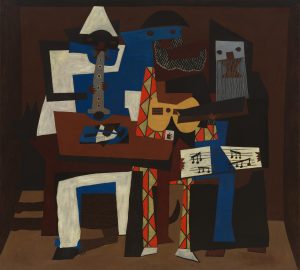
Three Musicians, Museum of Modern Art, 1921
Picasso’s personal life also was quite dynamic, marked by intense and turbulent relationships with women who had a significant impact on his art.
Professor Enrique Mallen, Director of the Online Picasso Project, will walk us through the major stages of Picasso’s life, and discuss the women and artworks that defined each period.
Speaker Bio
Dr. Enrique Mallen is a Professor at Sam Houston State University and is the Director and General Editor of the Online Picasso Project (OPP), a digital catalogue on the artist Pablo Picasso used by Picasso scholars throughout the world.
Professor Mallen earned his doctorate at Cornell University and has taught at Heinrich-Heine Universität in Düsseldorf. He has published numerous journal articles and has contributed to many edited volumes and encyclopedias. He has written extensively on Picasso’s Cubist and Surrealist periods, as well as on Picasso’s writings.
Professor Mallen has delivered lectures at international conferences organized by universities and museums, such as The Dalí Museum. He is a regular collaborator with the Museu Picasso, Barcelona, the Museo Picasso, Málaga, the Fundación Picasso Casa Natal, Málaga, the Casa Museo Picasso, A Coruña. He has served as a consultant on Picasso exhibitions at numerous museums, including The Museum of Modern Art.
Picasso: His Life and Art
He’ll talk about the evolution of Picasso’s art and the people he worked with, his relationships, et cetera, and how, how those things impacted his art. So, so that’s it. I would like to, uh, now introduce Enrique Mallon. Um, so as I mentioned, he’s a professor at Sam Houston State University. He’s actually the director and general editor of, of something called the Online Picasso Project, which is really a, it’s a digital catalog on Picasso online.
It’s used by scholars around the world. [00:01:00] And he, he studied at Cornell. He got a PhD at Cornell, and he’s taught at the Heinrich Kind University in Dusseldorf. Um, as a scholar, he’s published a bunch of journal articles. He’s contributed to many edited volumes and encyclopedias. He’s written extensively on Picasso’s, cubist and surrealist periods, and also on Picasso’s own writing.
So Enrique has written about Picasso’s own writing things that he wrote. Um, he lectures at conferences, um, organized by universities and museums. We’re actually referred to Enrique by the Dolly Museum. The Dolly Museum, um, gave us a talk last, last spring about, um, uh, oh God, that art. Dolly Salvador Dolly.
So, um, so this is, uh, I’d like to welcome you Enrique, to empower you.
Speaker 2: Hello.
Speaker 2: I have a PowerPoint, so I will be sharing the screen right now.
So, so I will turn my video off now.[00:03:00]
Speaker 2: I, I hope people can see the, the screen. Um, so the, the, the title of my presentation is Pablo Ruiz, uh, Picasso, um, the most influential and prolific artist of the 20th century. Um, so I’ll be talking about how Picasso, um, was really prolific for one thing. I mean, he, he, he said the, the estimated number of works of Picasso are 50,000 works.
And so you can see a lot of the works that I will be talking about. All the works that I will be talking about on the online Picasso project has already been mentioned. We have already cataloged 40,000, uh, almost 40,361 works to be exact. And so, um, you will see a number, an OPP number that refers to the online because of project.
And you can check any of these works, [00:04:00] uh, later. Uh, if you want to, to access the online Picasso project, you just go to picasso.shsu.edu and it’s completely great so you can access it and, and examine it. Do you need to, to get a password? But the password is granted to you when you contact us. So, Pablo Picasso is definitely, um, the most influential and prolific artist of the 20th century.
Like I said, uh, he produced about 50,000. Um, he was groundbreaking. His, uh, his innovations and versatility and artistic brilliance is known to everyone. Um, everybody has heard about cubism, for example. Um, he was very influential also during the surrealist period. Breton and who was, you know, a major figure in surrealism.
He actually said that Picasso, that surrealism had to go through Picasso. So he was a major, um, figure already in his lifetime. Also, another thing that is interesting about Picasso is the fact that he had a [00:05:00] diversity of styles. He didn’t stick to one particular form. Uh, not only that, but he also used different techniques.
So, for example, a lot of people know, but because of the painter, but Pica, it was also revolutionary as a, as a sculptor. And he also did ceramics. He did, uh, lithographs, um, uh, he did, uh, etchings and in every, any of these, uh, areas he, he programmed. So basically he, he was, uh, innovative in everything that he did, and sometimes even confusing people.
For example, when he did lithographs, um, he worked with some professionals in that field. And, uh, they were shocked by the things that he wa that he was able to do. The same thing with ceramics. When he started working with ceramics, a lot of people said, you know, that you can’t do that. But then he did it.
And of course, it was a major revolutions, for example, in ceramics. He was so revolutionary that the town of Valise, where he lived and where he started to do ceramics, I had kind of gone down after the war to World War ii, [00:06:00] and because Picasso started doing ceramics in that town, the town was revitalized.
So that’s kind of the influence that Picasso was able to have. So, always Picasso, you cannot understand Picasso without, um, knowing his background. Uh, we know that Picasso was a Spaniard. Uh, he was born in Malaga. And, uh, as, as you can see, Malaga is, uh, I put a little dot there, uh, in, in Spain, Southern Spain.
You can see how distant it is from the rest of Europe. Uh, so you would imagine that, and of course, that far away. Um, Malaga at the time was very provincial. Uh, it was far away from Madrid. Who was it? Which was itself, uh, quite provincial. And, um, Barcelona was maybe the city in Spain that was, you would, he would say more in touch with what was going on in the rest of Europe with Paris and, uh, Berlin and so on and so forth.
So, um, he was born in 1881. Uh, of course he nine, he died in 1973. So he’s very much a, a [00:07:00] man of the 19th century in some of the things that he did. Um, and of course he lived all of his life in the 20th century. So you have to understand Picasso in that context. And some of the things that he did, some of his attitudes to what, uh, towards females.
Um, they’re, they have to be contextualized because, I mean, it’s, it is, there are things that are not acceptable today, but at the time it was, uh, un unfortunately, the. Uh, his father was Jose Luis Blasko. He was a painter and art, art teacher, and that’s very important because, uh, he saw a Picasso in the, in, in the art world.
And his mother, uh, was Maria Picasso Luis. So he actually adopted the, the, the name of the, of his mother, Ru being such a, a, a fairly common name in Spain. So that, that’s the reason why he’s, he’s known mostly as Picasso, but his, his full name is Ru Picasso. So, um, he started working at the School of Fine Arts in Malaga, where his father, uh, his started, uh, [00:08:00] taking classes at the School of Fine Arts in Malaga, where his father was a teacher.
Um, and then, uh, eventually, uh, his father being, uh, an art teacher, he would be transferred to different, uh, places. So one of the places that he was transferred to is, um, so he, so Picasso was, uh. Starting, um, to go to school in Malaga, but then soon after he was transferred to, uh, to Laia. So the family moved to Laia in 1981.
Uh, and his brother gets a teaching position there. They to de uh, and because of stars taking classes and even when he started taking, uh, classes with his very early age, you can see that he was pretty, pretty good in, in, in, in drawing and painting. So these are some of the works that he was doing in 1894.
Um, already in, uh, in, uh, the one on the left is a portrait of, uh, his sister Lola. And then the other one on the right is an [00:09:00] aca,
Speaker 3: one of
Speaker 2: a study, uh, academic, uh, study. Um, and he did many of these and everybody was really shocked by the feasibility in drawing. So a lot of people think that when they see some of the works that, uh, of.
Late Picasso that he couldn’t draw. But when we look at these, uh, pictures and, and drawings and uh, and oils, you can see that that is not the case that Picasso was actually very, very capable of doing representational painting. So, um, when they transferred to Barcelona, because it was about, um, uh, nine, eight or nine years old, um, he was accepted to the School of Fine Arts in Barcelona.
You can see a picture there on the, on the left. And again, every time he was, uh, he went into one of these art schools. A lot of people, uh, were amazed about his, his capacity, how, how he was able to, to do, uh, conventional art, uh, in a, in very, very, uh, proficient way. So he went very, very [00:10:00] fast through school.
So one of the first works that he did, you can see for example, the 1895, uh, there he did a lot of representations of old people. Which is also interesting for Picasso because, I mean, being young at that age and starting his career, um, that didn’t keep him from representing things that were, that were of his interest.
So in this case, for example, Picasso has always been interested in aging, the process of aging, age, uh, death, and so on, so forth. And also, Picasso is going to incorporate very often, uh, friends, relatives, uh, family members in some of his paintings. So for example, here in the 1895, first communion painting, the man that is standing beside, uh, the, the girl that is doing, going through first communion, the girl is actually his Lola, and then the, the, the man is his father, and then the woman behind is the mother.
So this is kind of an incorporation of elements of his own life, uh, into his art. He is also has been [00:11:00] arguing now 1895. Uh, he has another, he had another sister. Um, conta, who unfortunately died, uh, from an illness and he’s been argued that the reason why you have two of the candles there blown out is because, you know, it’s basically, uh, he’s showing that there’s something missing, that there’s another member of the family that could have been in the portrait.
But, but it’s missing from that. Um, again, in the here you can see, uh, representation of his, uh, mother, for example, uh, in 1896. And you can see his, his skill is a, is amazing. This is a, a pastel. So the, the kind of technique you have to be very careful. ’cause if you may make mistakes, uh, is very difficult to correct yourself and you can see how it’s executed very efficiently, very quickly, and very, very precisely.
And if you see photographs of of his mother, you can see that it’s a true representation. For himself. However, we, we see that Picasso very early on already in [00:12:00] 1996, he, he was pretty creative with his own portrait. So for example, we can see how he’s doing his, uh, his hair there, um, kind of in a more of kind of a wild person, uh, technique.
So he, because he’s, he is representing himself as kind of a romantic writer, a romantic poet, uh, of some sort. And he’s aging himself. So Picasso here, uh, looks older in the picture than he actually was. And so Picasso is also always going to be very, very creative with, uh, not only is he going, going to include members of his family and, and friends and and so on and so forth, but when he paints himself, he’s also talking about himself, who he is, who he wants to be.
This is one of the first, uh, paintings that Picasso did that were, uh, a success, uh, is called Science and Charity. Again, we see the, the representation of the, the person sitting as the doctor, uh, taking the pulse of the woman is [00:13:00] actually his father. And, uh, and then the, the girl, uh, the, the girl that is representing the, the nun is actually, um, his sister.
And so you can see, you know, how he’s adding elements, uh, to this, this is a very conventional painting at the time. Uh, this was a very common thing to represent, um, uh, actions like this, you know, where you have a, a sick person in bed. Uh, they’re basically trying to, uh, move the viewer, uh, into the, into the painting.
This is what we call symbolism, uh, painting. And so this is kind of, is going to be the first phase of Picasso, this kind of symbolism. That he’s going to implement. And this is going to be followed, um, through several years. Um, but this symbolism, when he moves to Barcelonas, we’re gonna see, um, uh, next. So here you can see a portrait of the father that he did, uh, on the left, and you can see how the father is, [00:14:00] um, um, also represented in the science and charity.
This painting actually got an award when he was presented. Um, and so it was, it was a success. And this was important because, because, because I started already being successful at the beginning of his career. And, uh, when you start being successful like this, I kind of, uh, grant you some freedom that you can do certain things because you know that you’ve been accepted in the, in the field.
So one of the, uh, very important steps the Picasso takes in 19, in 1980, uh, 1900 is he’s moved to Paris. So he goes to Paris. The reason why he goes to Paris is because there was a painting that, that had been accepted, which is amazing for somebody that young, um, to be shown at the international in, uh, in Paris.
And you can see this is the pictures of the, of that, uh, international exhibition. And Picasso was there with, [00:15:00] uh, some accepted masters. Uh, the painting that was actually included in that was on the same theme as we see in science and charity, again, of a dying person. And so, so what? That painting has disappeared.
Very interestingly. We didn’t know what it was, but then it was found years later. And I’ll show you where that painting is right now. But, um, this is the painting that was, uh, shown at the, in, um, in Paris. So at first Picasso, when he moves to Paris. And, uh, another thing that we know about Picasso is that he was very interested in language, uh, the language of art.
So he’s, he thought of, uh, painting as, as a way of communicating, uh. Either learning something or communicating, uh, an idea, a thought. Uh, it’s a means of communication. So at first he’s going to explore different languages. So it’s very typical of Picasso when he first gets to Paris to imitate some of the post impressionists.
As you can see, some of the early paintings of, uh, his remind us very, of very much of [00:16:00] paintings by, or Van Gogh and so on, so forth. You can see the painting, for example, at the bottom, the, the dessert you can see there, um, that some of the brush works and are they know for, uh, in, in Van Gogh or the painting on the top, uh, is very much like, uh, some of the paintings that you see to those and some of the other painters.
So this is where he starts. He’s basically started, um, looking at other people, other people’s languages. Um, at first because it was accused a little bit of plagiarism because people thought that he could just, he was imitating them. But what Picasso was actually doing is exploring the language that he used to see what language that best fit.
What he wanted to do with them. Uh, we cannot forget that Picasso was very aware of languages. I mean, after all, he was, um, he started in Malaga speaking in Spanish, and then he moved with his family to Barcelona and he spoke fluently, uh, Catalan. And then eventually when he moved to Paris, he’s going to become fluent in, uh, in, in [00:17:00] French.
So Becauseso was very much aware of this different languages. So this is also going to have, uh, an impact on his painting.
Speaker 2: Well, that’s the thing. A lot of pe Picasso is known mostly for the composition, uh, for the drawing.
He was mostly, uh, a draftsman, um, and second, uh, a colorist as opposed, for example, to Matisse. Matisse is known for his colors, uh, more than anything else.
Speaker 3: Mm-hmm.
Speaker 2: But he, when he did colors, sometimes he could, he could do, he could do really well. And you’re gonna see some of the paintings that we’re gonna look at, his colors are incredible.
For example, some of the works that he did in the 1930s, 1932 in particular, uh, the colors are very brilliant, very bright, and uh, they’re very attractive. So Picasso could do colors very well. So that’s another thing that, that his ability to kind of do different, [00:18:00] uh, different things. So he wanted to, because it could have stayed with the same thing.
I mean, he could have continued doing, and he did quite a few. He did an exhibition in 1901, uh, at the, uh, um, bra, uh, gallery, which is a very prestigious gallery at the time. And, uh, he was a success. So he didn’t change styles because his painting was not accepted, was not going well. He changed because he wanted to change, he wanted to explore different languages, like I said earlier, to communicate different ideas or to, to see how the language of painting could be expressed in different ways.
Speaker 3: Wow.
Speaker 2: So we see in, uh, in 1901 after he goes to Paris, there is a major, um. Event that happens is that his friend, uh, Carlos Ka, must commit suicide. And this has a major impact. This is the, the friend that went with him in 1900 to to, to Paris. So they kind of share the pain of the beginning of their career in Paris.
Um, [00:19:00] very, you know, very poor, uh, starting, not recognized, uh, uh, people not buying their art at the, at the very beginning. So even though he was, he was having success in Spain, when he gets to, uh, to Paris, he’s a nobody. And so, um, Kamas was a very close friend, and see he kills himself and he kills himself over this female person that was, uh, this woman that we see here on the, on the, on the left.
Her name was Ger er Garo. And, um, uh, he was, he fell in love with her. Um, and she didn’t feel the same way. So basically he k he killed himself. And this is going to introduce what we normally call the blue period where Picasso is going to. Turn into a, basically the color blue as a feeling of sadness. Uh, but it’s not only sadness, but also poverty.
You have to remember that Picasso’s going through all these things at the very beginning of his career. He’s not, he [00:20:00] doesn’t have a lot of money. He’s not accepted. He’s being rejected. So it feels like a really, a beggar, uh, to a, to a certain degree. So this combined with the fact that his friend, uh, killed himself, um, is what we see in the so-called blue period.
And also, uh, like I said earlier, he maintains that kind of symbolist, uh, idea because the paintings cannot be taken as true representation, but they’re always symbolic of something. So, for example, we see how Picasso here in this painting, he kind of ages himself. Um, uh, he, he looks older than he actually was.
When we look at, uh, pictures of Picasso, you can see here of 1901, he was definitely not. As bad. He didn’t look as bad as he, as he portrays himself to, to be. And only the coat that he, uh, that he puts on himself, you know, bigger than he actually is. It makes him look smaller. So, um, what he’s trying to represent is not just himself, but also kind of a symbol of the artist, of the abandoned artist, a recognized artist.
And there is a [00:21:00] lot of ngal in this painting. Also, you can see some of the, uh, um, uh, brush strokes are very, very much, um, uh, vango, especially if you, uh, close in on the, on the face, which you can do on the Picasso project. You can see how Picasso is representing, uh, himself as the misunderstood artists or not recognized artists.
So he’s going to be doing a lot of these paintings of blue paintings, um, very often re representing the, the rejects of society. So here beggars, uh, prostitutes, uh, and so on, so forth. So here you can see, uh, the famous painting in Chicago. This is the guitar player. Picasso again, not only represents um, uh, a beggar, but he also uses all kinds of symbolic, uh, elements.
For example, you can see the way he’s crossing his legs, the way, um, he’s kind of basically creating a cross with the windows and the, and the floor. Uh, Picasso has in mind, uh, kind of the idea of a crucifixion. So when we look [00:22:00] at the guitar player, it’s not only a guitar player, but he’s actually a sacrificed individual.
So he is the artist, uh, presented as a victim of society. And this is how Picasso is going to, to portray himself, uh, during this period. And then in 1903, he does a, a, an important painting. One of the most important paintings, uh, that he did in this period, uh, he went through different stages. And in this is called lice.
And what this painting is incredibly, uh, fascinating because one of the things that people have done x-rays of the painting. What they discovered is actually underneath this major painting of 1903, is the canvas that he had brought and was exhibited in Paris in 1901. So Picasso basically brought it back and then recycled the canvas.
This is very typical at the time of, because of, because he was poor, he didn’t have a lot of money, but also he liked the idea of revitalizing a bringing to life, uh, a painting that [00:23:00] was, uh, a, a previous attempt that he had made. So this is a fascinating painting Also, um, another thing that is interesting, the, the, the, the man that is represented there is Casas.
Okay? So we know that from pictures of Kamas, that is actually a, a representation of him. When Picasso was doing this, painting, an early stage of the painting, and we know this from X-Rays actually has the page, the face of Picasso. What Picasso did, he basically brought his friend back to life, just like he brought the painting back to life.
You can see in the x-ray, the, the painting. So there was a light, there was a, here’s a, this is a bed and there’s a light, and there’s a dying person. This is the painting that he brought to Paris to be exhibited. And the, uh, so, um, so basically he’s doing these for symbolic purposes. Okay. Also, the gestures that he’s, um, um, he’s pointing up to the, to the female over there.
And we know [00:24:00] that the relationship between, um, Kama and German had broken down. So he could, he could be indicating here the possibility, something that could have happened in that relationship. But of course, uh, never, never did. So he’s basically recreate, giving life to, to, uh, Kasima by saying he could have narrated, uh, German, they could have, uh, had children, and so on and so forth.
In 1904, Picasso starts transitioning to what we normally call the Rose period. And again, this is a fascinating, uh, painting. Picasso represents himself again, like I said earlier, is not a true representation of Picasso. Picasso represents himself as a Harlequin, uh, Harlequin. And, uh, and you can see that the woman beside him is actually German.
So Picasso again is, uh, kind of, um, playing with events in his life. So German was the one that caused the death of his friend, uh, to a certain degree. And then Picasso is kind of representing himself as a Harlequin. The [00:25:00] Harlequin is the figure of, um, basically the, the, the, the person that comes from the other side, uh, the Harlequin, um, is, uh, etymologically is related to, uh, uh, um.
To the word, to the person that comes from the other side. So he is basically, and he, the, the outfit that he wears basically is not here, not there. It’s kind of a transition element. And because of, was very interested in this. So by representing himself as a Harlequin in this particular painting, uh, he’s representing himself, somebody that comes from the dead.
Uh, and so he’s actually portraying himself, but also casa in this painting together with German. And this is the kind of basically the idea that he does very often in his paintings. Uh, in 1904, he finally settled in Barcelona. The very beginning. Becauseso went back and forth. Uh, he went from, uh, Paris to Barcelona and you know, he, he would go to bar, spend several months in Barcelona, then go back to Paris because he was not having [00:26:00] success at the very beginning.
But, but 1904, he settled, uh, in, uh. In Paris, and he lived in the, the, the painting, the, the place that was called Levo, that you can see there is kind of rundown, uh, studio, uh, where some of the poor people, uh, poor artists lived. Like you can see, for example, max Jaco lived there, so, so forth. So it, it’s a very poor, uh, very, uh, um, basic, uh, uh, living arrangement.
And while he’s there, he meets, uh, Fernando er. So this is gonna be really the first serious relationship that Picasso is going to, to have. And he has been argued that, uh, to a certain degree, Fernando Olier is going to bring that transition to this second period, uh, that is so-called Rose period. Picasso has now settled, uh, in, in Paris.
He’s having a certain amount of success. Uh, his paintings are being purchased now by people. And so he represents himself again here as a [00:27:00] Quin, but in a more, um. And a happier kind of surrounding. It’s almost like a new family. You can see here how all the members of the family are put together. One of the interesting things that, uh, has been argued is that this painting actually represents almost Picasso’s hand.
So Picasso, you can see that he’s showing his hand there as almost like a symbol. Uh, again, this is a kind of a symbolist painting, saying like, this is me. Uh, my hand is almost like my fingerprint. And you have five members of the, of his family, uh, together, almost like a hand itself. Okay. Uh, so this has been said, uh, has been argued to be his friend, um, a Aire who was a, a friend, uh, poet at the time.
This has been argued to be, um, um, mark, Jack. And so, you know, so, so some of his prints are here grouped together. Again, this is a very important painting. Eventually when this painting is sold, uh, it would sell for an incredible amount of time, uh, [00:28:00] money. This was important. Pica’s career, like Picasso would say later, is a success of my rose period that allowed me to do some of the things that I did afterwards.
Like I said, if you of you’re successful, then you can be, uh, creative. This is, uh, another painting that he did around this time. This is actually started as a painting of Max Jacob, the poet that I mentioned that lived in the, and then he basically recreated, uh, oh. So he started as a very representational art, uh, painting.
But then he added these flowers, uh, that creates kind of an atmosphere that is very symbolic of a poet, uh, living in another, in a higher dimension. And then by 1907, Picasso, uh, kind of transitions into, uh, uh, a major, um, change, which is, uh,
Speaker 3: uh,
Speaker 2: we normally know, know this as proto cubism. This is Laima at the time, uh, was not, um.
Recognized was not accepted by, even [00:29:00] by artists like Matisse. Uh, some of the, uh, colleagues that he had around, uh, they thought that Picasso had basically gone crazy. And a lot of people have seen here different influences. For example, you can see the influence of Iberian art, um, in, especially in the two, uh, uh, females in the, in the center.
But you can see African art also in some of the, some of the other figures. Uh, one of the reasons it’s been argued that this painting was not accepted at the time is because it is not consistent. It’s an inconsistent painting in the sense that you have a combination of representational, because you can see the five figures, um, in what is supposed to be a brothel.
Um, but then you have different styles being implemented. You have Iberian, sort of an Iberian look in these figures, but then you have more, uh, primitive look in these, um, other, um, site, uh, figures. So the, the, this kind of idea of having a painting [00:30:00] in transition, a painting that is not completely finished, um, was not accepted.
And because actually that’s what exactly what he liked, he, he, he was quoted as saying, uh, when a painting is done, is done, finished dead. Uh, so a painting should always be left unfinished for the viewer, maybe to finish it, uh, but not for the painter to finish it, uh, himself. And then of course, that is what I, I I refer to as product cubism.
This is, uh, 19 0 9, 19 10 when Picasso storage to go into true, uh, cubism. So the first one here, you can see some of the paintings that he did in Orta, a town that, uh, that he, he spent some time, uh, um, in Spain. Uh, this is normally called Cian Cubism. And you can see how Picasso’s playing with the, the idea of cubes and hence the name.
Um. In this, uh, he basically shared it with his friend, uh, George Rock, [00:31:00] that also implemented this kind of cubase approach. Uh, it almost looks like things are kind of cubes put together into the, into the composition, but that transition into what we normally refer to as analytic cubism. And you can see that painting in 1910 where it becomes almost, uh, abstract.
This is actually his dealer, uh, gun vier. And, um, as a matter of fact, an early stage of this painting, um, was even more abstract. And, and the, the reason why you can recognize some of the features is because, because added them later. So you can see, for example, the eyes, uh, here in the, in the area. You can see the mouth, you can see the hands, uh, you can see the, the difference between the jacket and some of the surrounding.
Uh, Picasso, he kind of implemented that a little bit later, but at one point it was really abstract and that’s the direction in which he was going. So you can see here, uh, the painting in a, in a larger. View. And then, um, from analytic cubism, he trans [00:32:00] transitioned into synthetic cubism. Synthetic cubism basically is the idea of, um, the language of art, being cre, being creative.
So art doesn’t have to be representational, in other words, doesn’t have to have a reality. That art represents art could create a new reality. So here we see that Picasso is basically putting things together that don’t exist before. So here you can see another thing that is in incredible about here is the combination of elements.
Uh, so for example, Picasso did, um, uh, a piece of, uh, uh, uh, something that you use on a table, right? Like a, a tablecloth sort of material. And he just basically cut it up and pasted it on it. And so he has that and he has also a. A rope around to represent wood. So you can see it’s a combination of elements.
And of course you have the paint itself. And this also is, uh, he’s playing with the idea of, so this is [00:33:00] supposed to be a painting, um, but it’s also supposed to be a table. So he’s playing with the idea of tableau in French, which could mean also be, you know, kind of the, the, the idea of a table. So this could be either a, a representation of a table seen from on top, or it could be a mirror that is representing, uh, a chair and a table, um, you know, at, at, at a cafe.
So this is, this is considered to be the first, uh, collage. So Picasso introduced that is the idea of mixing different elements. So a painting doesn’t have to be done with exclusively with oil, but you can use it with different elements. Um, and so this is what, uh, is going to start this new style. Then towards 1912 PSO meets, uh, another person, uh, Fernando, Olivia, his relationship is, is going to decline and he meets, uh, um, Eva Goel.
And this is actually a representation of Eva, uh, GU, uh, the see there. That is [00:34:00] the second relationship. And he basically, she, uh, introduced this new, she was really behind the synthetic cubism. We know that she, uh, was a seamstress. So it has been argued, uh, that maybe some of the cutouts that he did for her clothing, you know, when he was, when she was making some of the clothes, influenced some of the pap coli or some of the collages that Picasso was, uh, was using.
The relationship was very short because unfortunately, Eva died, uh, which is going to have an imp uh, a very serious impact on his, on his light. Uh, so he, 1915, he does this painting as she was dying of cancer. You can see how Picasso is representing, again, himself a Harlequin. But in this case, uh, this painting actually started as two dancers.
Presumably Picasso dancing with Eva, but then towards the end it represents just one figure, Harlequin. Um, also, um, some people have seen the outline of Picasso’s head Here. You can see that. [00:35:00] You can imagine him. So this is a, a portrait of him, of himself, um, mourning the death of, of, um, the painting is really abstract.
You can see how Picasso, um, moved towards abstraction in synthetic cubism. You can see, uh, here is an example of a, of another paintings related to that. You can see the two dancers here a little bit more clearly. You can see the arms and you can see a male and a female with a skirt. So this is how the painting started, but then it transitioned into just one single individual.
Then, uh, about 19, uh, 1917, uh, Picasso got involved with the ballet, which is very, really interesting. Uh, he kind of decided to move away a little bit from cubism. Uh, one of the reasons for that is because a lot of people were basically imitating him, and so he thought that it would be best for him to kind of move away and to show the world that he could do other things, um, and do things differently.
So he, [00:36:00] he went to Rome and he met Olga Klo, uh, a ballerina in one of the Russian ballets. And, um, he started doing more representational painting. So this is what is normally known as the Neoclassical period, and you can imagine the shock of people when, uh, Picasso went from those synthetic paintings. To these kind of representational painting.
Uh, and more neoclassical, of course, still being very creative as because who is, because I mean, this is far from representational. You can see that the arms are fairly long. So p he is actually playing with the language of classical art by doing his own implementation of it. Uh, this actually, this painting of Olga is based on a photograph and it’s fairly reputational, but notice that because of very interesting paint, he leaves the painting unfinished.
You can see the, the, the, the background is left undone. So this is actually the canvas. So basically is the idea to say, yes, this is a representational painting, but it is a painting, it is [00:37:00] a work of an artist. And so it’s not something that should be taken as a, as a photograph, as reality painting is painting.
Reality is reality. So it’s the idea of painting, being creative. Uh, this is another painting that he did, uh, in 1923. Uh, again, this is the Neoclassical period. Um, but you can see how, again, p it’s being there, creative, uh, uh, and like I I, I mentioned earlier, p it’s mostly a draftsman. You can see how the precision of the line is a line that is very often unfinished, and then the color is applied second to it, um, very often crossing the borders.
Yeah.
Speaker 2: Yes, because Picasso is basically, um, he’s, he’s concentrating on the line mostly. If he concentrated on construction in during synthetic cubism, uh, you’re gonna see that in [00:38:00] the Neoclassical.
And actually moving on to the, uh, the next period that we are gonna see, um, he’s mostly interested in the flow of the line and how the line defines, uh, its own existence. Yes, the comal, the compositional structure of it is not as complex, of course, uh, as, as what we saw with the cist. Uh, here’s another painting of, of Neoclassical 23, and this is how Picasso is trans transitioning towards, um, basically kind of a, another, another dimension.
So there is a whole, a whole thing of dream world, uh, in these, uh, depictions now, they’re now representing individuals that he, that he actually saw, they’re imaginary people. So this is the, the flu plan of Pan and Becauseso is representing, uh, kind of the classical world, but in an imaginary. So he, Picasso is moving to the dream world, which is gonna be fundamental for his Cuba period.[00:39:00]
And this is in 1924. This is a critical year in Picasso when Picasso, um, is moving towards more of the surrealist, uh, style. This is supposed to be a still life with two guitars. You can see the guitars and a bottle in the middle, but you know, it’s, it’s hard to judge. What is interesting, how Picasso is reverting a little bit to cubism here, but it’s doing it differently.
You can see the flow of the line, like I mentioned earlier. So you can see, uh, the shape of the, of the guitar, the round shapes, um, they’re almost, uh, exist on their own or even the, the, the tablecloth that is sitting on top of the, of the table. What is interesting about this is that you see this at different levels.
You can see this as a steel light. Uh, you can see this, uh, some people have seen in this a, a lying female, a model lying on the chair. But actually what’s interesting, if you superimpose a, a skull on this, uh, it could also be read as a, as a [00:40:00] self portrait. So these would be the two eyes, and you can see the bottom would be the teeth of the skull.
Because he was very interested in this kind of idea of deaths. Like I said, from very early in his career, in his life. He was interested in aging, uh, the idea of age, death and so, so forth. So he could be there. As he’s painting his transitioning, he’s, he’s thinking about transitioning in his own life. Okay.
So this is a very important Yes.
Speaker 2: Uh, well, it depends on what, uh, what base of of Picasso. Um, in the, in the, in the Cubist period, of course, to Brock, um, that the one that he developed cubism with.
Uh, then we are gonna see in the 19, um, thirties, um, uh, you know, you can, you can see a lot of people have seen similarities between Picasso, Matisse, uh, in the colors that Picasso uses. So [00:41:00] I would say those two are major artists. Um. And, and Picasso was, uh, very aware of that, of the influence that these two artists had on, on him.
Speaker 2: So here’s 1925. Uh, his life with, uh, with Olga was not going very well. The ballerina that he met and is actually supposed to be started as a representation of, uh, of Olga. You can see Olga. There is a ballerina, and you can see how Picasso is basically deforming, uh, Olga almost intentionally. And what it it does is again, he kind of refers to the kind of symbolism, uh, of a crucifixion.
So he’s basically representing the female in the middle, not just as a ballerina, but, uh, crucified, um, individuals, a victim. And the two people on the, on the two sides are, um, also kind of, it started as, uh, ballerinas, but then towards the end, uh, they’re all hard to, to, to, uh, interpret. Here. We see, uh, in [00:42:00] that area.
Uh, basically the outline of another figure that Picasso added, uh, later on in 1925. He was in Monte Carlo at the time, and, uh, uh, a good friend of his Ramon Piot died at the time. Ramon Piot, who presumably is in, is shown in this painting because he just died, actually had married er, who is the, the woman that I, I show there on the left, who is the person that caused the death of his friend, uh, Kama.
So you can see how Picasso car relating, I mean, 20 years over 20, uh, years later, he’s kind of putting together things, right? So bringing his friend Aon Haw back to live in his painting, just like he did with Kamas and Ramon Piot is related to German, just like Kama was related. So you can see in the sense how Picasso’s painting cannot be understood without looking at his biography.
Um, what, what things were happening in his life. Uh, in the 1930, then [00:43:00] late 1920s, um, early 1930s because of meets another woman, uh, Maria Tere Walter, who was a young woman and she would have a, a tremendous impact on his life. Uh, he basically separated from Olga. Uh, the relationship was not going very well.
She was the one, Olga was the one presumably that kind of pushed him towards more of that neoclassical style to a certain degree. She was fairly conservative, uh, and she thought that that kind of painting would sell better. And so when as he moves away from Olga, he returns to kind of these more, uh, abstract, um, uh, sort of painting.
And the paintings that he does at Maria Tere are always very sensual. Uh, this, for example, this one, uh, it’s called The Dream. Um, she very often is represented, uh, dreaming in this kind of world. And the colors that he uses are always, uh, colors that are very lively. We know that Picasso wanted to have another kid.
He had one, uh, kid with Olga. Uh, his [00:44:00] first kid was, who was named Paolo because since they met in room, they gave him the name Pablo instead of Pablo. They kid, they call him Paolo, but he wanted to have a second kid and Olga did not wanna have a second kid. And so he’s going to have a second kid, but now with Olga, but with, uh, Maria Teres.
And she’s going to be born in 1935. And that’s Maya Picasso, who is fairly well known that she just passed away not that long ago. This is, um, Maria Teres, and you can see that even the painting being very abstract on the left, you can see some of the features of her. So, Picasso’s, uh, representation was influenced by, by the looks of the individual that he represented.
You can see the curves of her hair, her nose, her chin are actually influencing the kind of style that he’s implemented. You can see that, uh, we could call this, and it has, that has been done. Uh, Picasso’s period has also, uh, have also been divided into, uh, [00:45:00] uh, periods related to the female companion at the time.
So for example, very, a lot of people call it the Maria period, or the Francois, uh, Francois, uh, period and so on, so forth. And we are gonna see that that’s the case with the next one. So this is what we, the surrealist, uh, period in Picasso and 1936, of course it’s a critical year because that’s the Civil War in Spain and Picasso was doing at the time, the kind of the dream world of the surrealist, uh, were they were tried to represent the subconscious, but of course the war kind of brought him back.
Uh, so we are gonna see that he’s going to move in to move away from this kind of neoclassical. Figures of the UR and so on, so forth, where he represent himself as the ur. And then this, of course Mayes. And this is Olga, presumably that he’s abandoning, transitioning towards, uh, Maria to, uh, of course, um, the representation of the war.[00:46:00]
And around this time, 1936, he meets another woman. Remember that Picasso was still married to Algar Kva. He’s in a relationship with Maria Terre and he meets another woman, Dora Mar, who is a photographer in 1936. And she’s going to be very influential. She spoke Spanish as opposed to Maria Tez or, or Olga.
So he has a more of an intellectual relationship with with her. And of course, 1937 is where the Civil War happens. And then of course, Ika happens where he is bombed by the Germans. And you can see photographs of Guernica, and that’s when Picasso does the famous ing, um, ika of that. So this is one Picasso kind of mix, uh, does a combination of things because here we can see elements of cubism, elements of surrealism.
But of course, he, Picasso is also representing the fact of the Civil War. Uh, so you can see, uh, well, he’s also bringing elements from classical times. So the bulge a certain degree could be read as [00:47:00] a ture, but he is bringing it. But he’s also representing, uh, Maria Terre as the female here. Uh, he’s bringing elements from the bull fight, uh, with the horse and the bull, uh, from Spanish culture.
So he’s combining everything at this point. And then of course, uh, the, the World War II happens and Picasso is in Paris at the time. So he is, uh, living under the occupation and he does representations like this. So Picasso said, uh, I never depicted the war itself, but you can see the war in my pictures.
And you can see this is a, a representation of an individual living under. Uh, the oppression of the German occupation. You can see that her legs are almost like bone, like, uh, some of the figures. So she feels like a, a tortured individual and also very often in his representation in the 1940s, that, that people are basically enc engaged, like a, they’re putting a sort of a enclosed environment.
And so that there, this is actually [00:48:00] self-representation to a certain degree,
Speaker 2: of Picasso. Uh, another painting that he did in 1942 is this one. Um, uh, again, we see the figure of the bull, uh, a bull, but it’s just to skull and he’s represented, uh, behind, um, a covered, uh, window. Again, very representational because in 1942, a lot of times at night, the windows had to be covered.
So this is actually because we represented the death of the environment that he was living under the. The, the, the occupation, but also representing the possibility of death. I mean, a lot of people were being killed, were being murdered during the occupation. And Picasso was actually, uh, very much, uh, a person that of known person at the time, a known artist.
And he actually had been banned by the Germans. So if they knew where he lived and they could have, he could have been imprisoned at, at any time. He, he who he was not, but he could have been. And, uh, towards the end of the war p of the, uh, this, uh, painting, um, [00:49:00] um, Leni, uh, you can see the skeletons, uh, of people that, uh, people have said that this could represent, uh, a lot of the pictures of the concentration camps were coming out.
This could have been influenced, could have been influenced by that. But it’s also the fact Picasso went to see a movie of the, that had been taken of the consequences of the Civil War. And these are some of the scenes in the movie. And you can see the families, uh, being murdered in Spain were probably more affected him more than the, the, some of the pictures that were coming later on.
So actually it’s been argued that this is actually the direct influence on the, on the painting. And then, um, uh, in the 19, uh, 19, uh, 46, he meets, uh, another woman, Fran, um, he breaks with, uh, Dora Mar. He maintains this relationship with Mario Teres, of course, because they have a kid together. Ma Maya. But he starts a new relationship with, uh, with, uh, [00:50:00] Francois.
And this is Picasso, kind of basically his life coincides with the coming back to life of Europe, right? Europe kind of recovering from the war. And Picasso is recovering from the war himself. So this is the very happy period where he concentrates mostly on, uh, light. Like, um, so you can see for example, the representation of Francois.
He has a flower, uh, birth, uh, giving, birth, giving, uh, new life to things. This painting, uh, started very, very representational, but then he basically transformed her into a very simple, um, representation of a, of a flour. And then, uh, around this time, Picasso starts to get into other things as well. This is a very creative period, so this kind of revitalization that I was saying.
That I was mentioning earlier. He actually was true for Picasso because he started doing, uh, lithographs. He did lino cuts. You can see here very creatively. He did [00:51:00] ceramics, uh, he did sculptures. And so around this time, Picasso, basically, the, uh, he, he could do just about everything. He was doing every single thing.
Of course, he was also still doing sculptures. Uh, so he was doing, uh, all kinds of media. And then towards the end of his life, he breaks with, uh, Fran Francoise. He, she actually is the one that, uh, left him. Uh, they had two children. Um, Claude and Paloma. Picasso are fairly well known. And, um, but their relationship was not going well.
And so he meets another woman, uh, uh, Jacqueline, uh, Rob. And, uh, this is the woman that he eventually would marry after the death of, uh, of Olga because he never, he never divorced her. He had to wait until she died. And then after her death, uh, he was able to marry her and she was basically a major influence towards the end.
Um, you can see some of the representations that we have of Jacqueline, um, as very kind of stable [00:52:00] individual. Um, she actually was very, very important to Pica of the last, uh, years of his life because he allowed him the, the, the peace and quiet and um, and, uh, to, to, to concentrate on his work. Remember that Pica of this time, uh, was already getting old.
And so, uh, another thing that he did towards, uh, the end of his life, he basically went back to, um, some of the other paintings. He wanted to compare himself to some of the masters so forth. So you can see representations, for example. This is a combination of paintings by Pusan and, and David. Um, and Picasso is going to do a representation of, uh, or.
Basically inter reinterpretations of paintings by Quez, by Goya, uh, by some of the French masters, uh, Manet, and so on and so forth. And he wanted to see how, how, how does his language, his new language that he had created, how did he compare to the language of some of the other masters? And you can see how he does it in these paintings.
[00:53:00] And one of the last paintings that I wanted to talk about is this one that Picasso did towards, um, uh, the end of his life. This is in 1972. Picasso died in in 1973, and here again, he kind of ba basically goes back. It’s interesting to look at Picasso and to go back and forth. If you remember the old man that he painted very early on in 18, 18 95 when he was still, uh, interation between AIA and Barcelona, and Picasso was concentrating on age, um, the possibility of death.
And here Picasso even. Before dying. He didn’t know exactly when he was gonna die. He’s already portrayed himself as a, as a skull, as a dead person. So he’s basically looking into the future in these words. So when he was examining age, uh, dying, he’s very often interpreting the possibility that this could happen to him.
So again, uh, Picasso’s art is very much a biographical. And a few things that I, uh, that I wanna mention is, uh, in, in the, the fact that, you [00:54:00] know, Picasso is very influential, is that Picasso still, uh, very much accepted. Uh, as you know, Picasso is selling for incredible amounts of, of money. So, for example, this painting that we see here was just, uh, sold in 2016, no long ago for, you know, an estimated eight, 8 million to $12 million.
So what is interesting about Picasso is the fact that, uh, even though he’s an artist of the 19th century and 20th century. Even in the 2020 first century, he’s still very much accepted and appreciated. So that is incredible For somebody who did so many styles, who broke so many rules, um, the fact that people still admire and still want to have some of his words and at, at home.
And to, to finish, I would like to mention again, the Picasso project. So you can see all of the works that I mentioned on this presentation. And, um, many more. I said we have [00:55:00] so far, 40 or 40,000 works, uh, catalog there. Um, on the Picasso project, again, Picasso dot h hsu edu. You can see any of the works, but just contacting me and you get the password.
So with that, I will, uh, if you have any other questions, I’ll be happy to answer them.
But, um, I want to ask you, first of all, Bob, that the go. Okay. That’s an enormous painting, isn’t it? I mean, yes, it’s, I think I saw it in Madrid is it’s a, yes, it’s Madrid,
Speaker 2: it’s, and then Reina, Sophia Madrid.
Speaker 2: It’s huge. Uh, and uh, it basically takes a whole, the whole room is a whole room dedicated to it.
He starts off with the flowers, he keeps morphing this image. Just in the moment as he goes into something new, it keeps becoming a new thing. So I’m, I’m thinking about the fact that he produced so much artwork and he illustrated or demonstrated how he could just evolve things in the moment.
Speaker 2: Right.
Or did he, was it all just spontaneous?
Speaker 2: No, very much so. Picasso was, uh, for example, we have studies, but numerous stu, excuse me, numerous studies of, of the Kika and, uh, the, the, the, the nice thing about this is that, that he donated. Not only [00:57:00] did he, did he donate the, the painting itself, but the studies for the painting were also donated.
So they can, if you go to the Madrid, not only can you see the painting, you can see the studies for the painting. And it’s fascinating to see the evolution of the idea, how he’s basically developing the ideas for very simple draft, uh, uh, to a very complex, uh, painting. Wow. Another interesting thing about this painting is, uh, at the time, 1937, he was living with Dora Mar, the photographer that he was, uh, involved with, and she took photographs of the painting at different stages.
So remember the Picasso always thought of painting as being a transition, an unfinished painting. And a lot, a lot of people have argued that the painting is unfinished, that the ika is unfinished, really. So what is interesting about this is that you can see in photographs how he changes ideas. So for example, at one point as he was doing the Ika, he put some collage on it.
See, he put some pieces of material on it. To add color to it. And then he decided no, that that was not the way to [00:58:00] go. Uh, so he took him off.
Speaker 3: Wow. And
Speaker 2: so you can see how he’s constantly, uh, the idea of metamorphosis is very important to pica, kind of the, the painting transforming itself, constantly changing in front of you.
And so that’s the good thing. There is also a film, um, um, that, that was made of Picasso, how he, he basically is changing, um, the, the, the painting and how sometimes you kinda wish that he would stop because you like the painting the way it was. But he keeps changing it. And of course, you know, it is, once you change the painting, the painting is finished, uh, is is changed, but uh, the change is fundamental to Picasso.
Speaker 2: Mm-hmm.
Speaker 2: No. Aldi was more of a 19th century. He was a, uh, he was an old man, but becau by the time, because he was in [00:59:00] Barcelona. So there, there was no, um, no interaction whatsoever.
Speaker 2: they didn’t, they didn’t, they didn’t coincide because Dali’s much younger than Picasso. So he, Dali came actually, uh, when, uh, Dali first came to Paris, he, the first place that he went to see was Picasso.
And uh, and Dali said to Picasso, I’ve come to see you before now, before I even went to the move. And Picasso said, you did the right thing. So, and Picasso was also very, very helpful at first with, uh, Dali. He actually, uh, he lent him money. Uh, he, uh, connected it to some of his friends and so forth. So he was very, very, very much a, a promoter of, of, of Dali at the very beginning.
So [01:00:00]
Speaker 2: well, like I said, Picasso is mostly, um, he, he, he’s, the composition is fundamental for him. And that, you know, we see that in cubism, but even in this Ika, for example, you can see the triangulation, you can see that there’s a triangular form in the middle of the composition.
Right. And, uh, so Picasso has structured the composition, and then there, of course, there are two vertical areas to each of the side. So, uh, but he did, [01:01:00] when he did the composition, he started with that kind of configuration, and then he put elements inside of it, and he made them kind of match the structure.
So the, the structure almost directs the painting. You can see, for example, the inclination of this female that she’s walking, she’s walking from right to left. Uh, you can see that she’s following the triangulation in the middle area. Mm-hmm. And you can see how the bottom, the, the back of the horse also kind of, it’s being inclined or the table here that you see at the, at the end.
Everything is kind of organized by the composition. The composition is fundamental.
Speaker 2: Yeah. And one, one of the things that he did in the surrealist period, which is really interesting. So there is all kinds of crazy stuff because I mean, after all, that’s what the surrealistic, you know, kind of the dream world, the subconscious try to get all your obsessions, dreams, fears, frustrations out.
And so what Picasso does very often, he had, he creates a framework [01:02:00] in the background that is stable, but then on top of that stable framework, he have the craziness, uh, mounted on top. So very often what you see is a very kind of, uh, uh, kind of square composition at the, the background, and then a lot of circular elements in the middle of the composition.
Speaker 2: right. In a way, each have the balance between the craziness and the, and even, for example, we, when we saw that the painting of, uh. The, the, uh, the, the so-called the dance, which sometimes has been called, uh, kind of a crucifixion, a Olga, um, you can see that the background is that window very nicely set, uh, very stable.
And then right in front of that very conventional, uh, background, you have that craziness going on in, in the front of it. So that’s very typical of, because of kind of combining the two things. Uh,
Yes. Did you say, and, and they were, they were really impressive and unique. And I’m wondering was, was he, um, lauded for that? I mean, was he really in the art world? Was he praised for his ceramics as as much as he was for his paintings? He
Speaker 2: was, he was, uh, you know, he was very much, uh, at first people, you know, of course the people that he worked with, some of the ceramic workers.
Um, they, some of the things that they did were not conventional, so they thought, no, you don’t do it that way. I mean, you can imagine these people that have been trained to do things the same way, uh, you know, from generation to generation. And all of a sudden, here comes Picasso and he’s doing all kinds of crazy things.
And so they kind of said, no, that’s not how you do it, but ’cause you said yes, you can do it that way. And so, um, at first, you know, people reacted like that, but then eventually they saw the genius of Picasso. And of course, uh, like I said, it, it was a revolutionary, uh, um, [01:04:00] innovation there in the town. So much so that it has brought the, the town back to, to the public.
Speaker 2: But east,
Yes. Very early on. Yeah. Even
Speaker 2: in, uh, at, even in Barcelona, uh, a lot of people knew that he was, uh, very, very capable as an artist. Uh, that he was not only, um, very creative in, in how he did things, but also he was very good. He was very skilled. So that, that was a, is a known fact. And he was basically accepted.
And one of the reasons why we have so many of his works is because his family also recognized that he was very good. And so they kept every single thing that he did. Uh, so we have an incredible [01:05:00] collection of his art from very early age until the, the end. And Picasso was known to keep everything. So that’s another good thing.
’cause a lot of artists, uh, they destroy, uh, some of the work that they’re not happy with it. So Picasso preserved everything, and that’s one of the reasons why we have over 50,000 words of art, because it saved every single thing that they did.
Like, was he, did he receive commissions to, excuse me, to paint? Or did he just produce works and then put them bumper? No, he basically,
Speaker 2: uh, pica of very early on, um, one of the reasons is his dealer, um, or his, uh, uh, the dealer that he had come by or didn’t believe in exhibitions he didn’t believe in, uh, basically having him show at the normal, uh, conventional places.
He thought that it, somebody wanted to buy a painting by Picasso. They had to come to his gallery to buy the painting. And this is kind of new ’cause a lot of people went to these major [01:06:00] exhibitions, um, in order to show to the public what they did and everything get to be known. But gun Vier thought that if you really knew, and once he, once people knew him, they had to come to the source.
Uh, and so no, Picasso never one of the few things that he did. For example, Erika was actually commissioned by the Spanish government. Um, in, in 1937, but that’s one of the few paintings that he did by commission. I, uh, most of the paintings he did just ’cause he wanted to do the paintings. Uh, now he would do, uh, pictures, uh, portraits of people and so, so forth, but no, uh, as commission, uh, just basically because he wanted to do it and sometimes he gave it to them or, you know, they bought him, uh, from him, but not, not as a commission itself.
Speaker 2: Yes, he was, uh, Hemingway was a very close friend of his. Um, so Picasso always admired, um. Writers, uh, throughout his life. And I think it’s because of, you know, like I said, language was important to him. He was aware of language of differences between languages and for he painting was a language. And of course, eventually in 1935, he starts writing poetry.
And he, he wrote, uh, a few Blaze. Uh, so he was always interested by, uh, in, in writing. And some of the friends that he had were poet and were very influential. Maxia K was one of them. Uh, Gil Pollier was another one. Um, and then other ones, uh, later on in the 1930s, so, uh, ton, uh, in this realist. So he was very, very aware of the importance of, of writers.
Speaker 2: yeah, she was a major promoter. He was, she was one of the, she and, uh, her brother Leo, uh, were some of the first buyers of Picasso. Uh, they actually had moved. Uh, to Paris and they had money. Uh, you know, the family were, was, you know, not extremely wealthy, but wealthy enough that they could buy paintings.
And so there were some of the first people that bought paintings. And one of the in incredible things is that Gertstein had basically at his play at her place, um, she put all the paintings up on the walls and a lot of people would come to visit her and they would have discussions there and everything.
So it was kind of a way of showing all some of the works. So she actually not only promoted Picasso by buying his works, but also by showing the works to the rest of the table.
Speaker 2: you. Thank you. Fascinating though. I, I try to cover a lot of ground, so I hope I didn’t go too fast, but
You know, that, um, probably [01:09:00] a lot of people who feel like they like me, I feel like I know a bit about baa not an expert by any means, but a lot of really unique insights and, and works that I hadn’t seen before. So. It, it was, it was fantastic. So thank you very much. We really appreciate it. Thank you. Um, so that, that’s it for, for tonight.
And, um, I wanna thank Enrique and then, um, remind people that on Thursday I’ll, I’ll actually be, happen to be the person giving the talk on using chat GPT to teach yourself anything. Um, so until then, um, thanks very much and go out and empower you.